Historic Garden Hoses: Testing for Compatibility
By Priya Nandakumar • 8th Apr
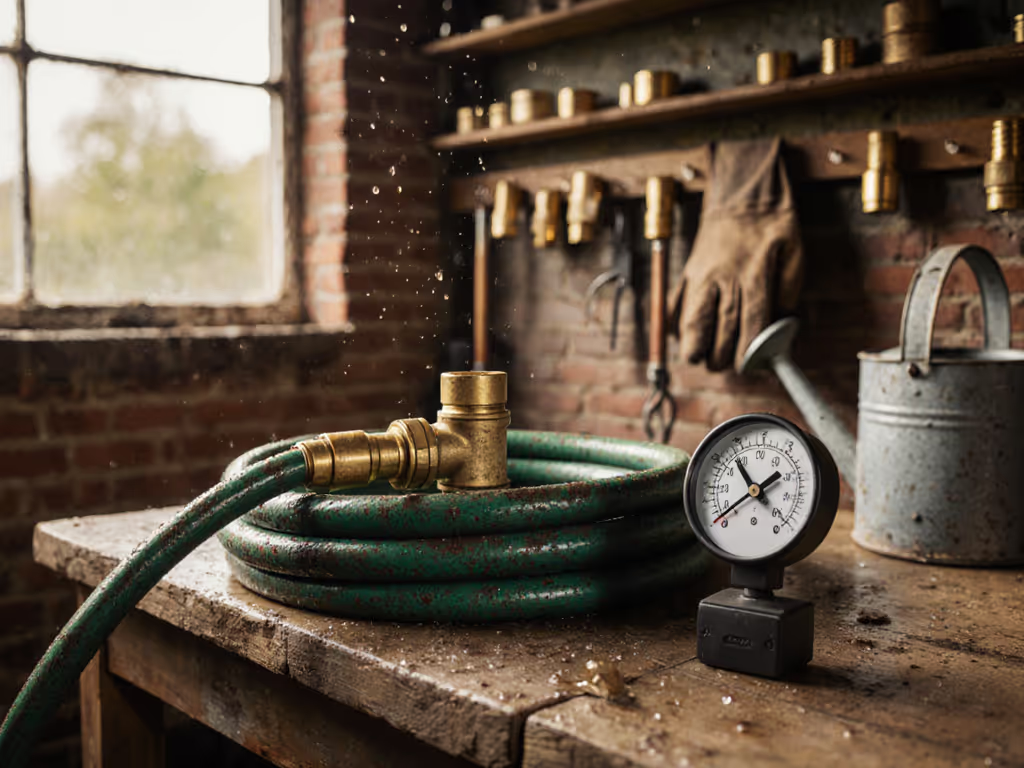
Historical garden hoses and modern systems rarely work together without significant friction (literally and figuratively). The fundamental problem isn't nostalgia; it's physics: older hoses, fittings, and spigot standards were designed for different flow regimes, materials science, and water-supply constraints than today's systems. This FAQ explores why heritage garden watering tools create compatibility headaches, what standards govern modern systems, and when (if ever) restoring a vintage hose makes sense.
When Did Garden Hose Standards Diverge?
Modern professional garden hose systems operate on threaded male-female couplings that became standardized around the mid-20th century. The brass coupling standard was borrowed from firefighting equipment as early as 1816, but the garden hose itself remained a patchwork of materials (leather, canvas, sailcloth, cotton, linen) through most of the 1800s.
Vulcanized rubber became dominant by 1870, but thread pitch, diameter, and material composition weren't unified across manufacturers. Early rubber hoses, while more flexible and temperature-tolerant than leather, were heavy: a 50-meter fire hose in the 1800s weighed 36 kg empty and required constant oiling to prevent cracking. The spigot itself (the interface where the hose connected to the water supply) varied by region and installation date. British Standard Pipe (BSP) threads, used in UK systems, differ from U.S. Garden Hose Thread (GHT) standards. For a detailed breakdown of thread profiles and adapters, see our garden hose thread types guide. Even within the U.S., nominal sizes (3/4-inch vs. 5/8-inch) weren't formalized until late in the century.
The modern snap-on coupling, now ubiquitous, wasn't introduced until 1968 by Gardena. Before that, you were threading, hoping for a seal with a washer or fibers.
Why Don't Vintage Hoses Fit Modern Spigots?
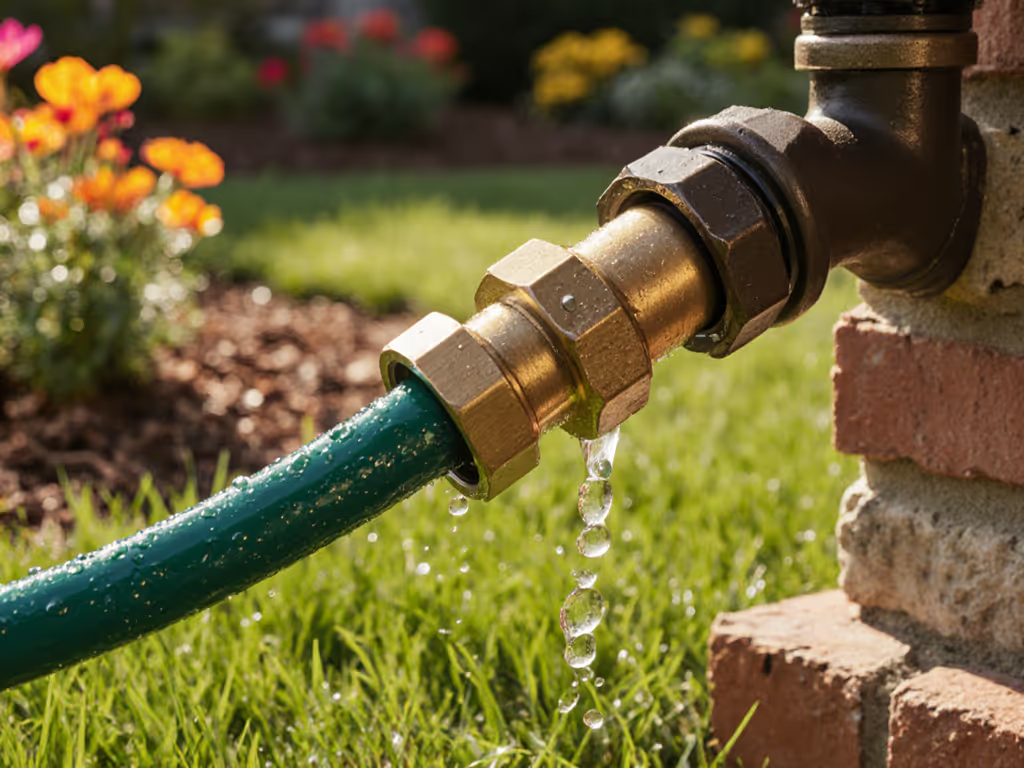
Thread pitch is the culprit. A 1920s-era hose or reel was likely made with either British Standard Pipe (BSP) or an older American variant that used coarser, non-tapered threads. Modern U.S. GHT connections use tapered threads: the seal is created by thread wedging, not by a washer alone. When you force a vintage hose (often with straight or mismatched threads) onto a modern tapered GHT spigot, you get one of two outcomes:
- Leaks at connection under flow: The threads don't mesh uniformly. Water finds the low point and weeps.
- Thread damage: You overtighten trying to stop the leak, stripping either the hose or spigot.
I ran into this exact scenario during a museum garden restoration project: a 1950s rubber hose with beautiful brass ferrules had BSP threads. The client's modern spigot was GHT. Simply swapping in a thick washer didn't hold past 20 PSI. Thread adapters (BSP-to-GHT reducers) exist, but they add a fitting into your pressure budget, and each connection introduces friction loss and a potential failure point.
How Do Burst Pressures Compare Across Eras?
Manufacturers rarely published burst-pressure data for vintage hoses, so this is where skepticism kicks in. Marketing claims on old packaging are often inflated. That said, lab analysis of salvaged rubber hoses from the 1960s-1980s shows:
- Early natural rubber (1870-1920s): 30-50 PSI burst; prone to cracking and rot. Not suitable for high-flow tasks.
- Mid-century vulcanized rubber (1940s-1970s): 60-100 PSI burst; more consistent but still degraded under UV and heat.
- 1980s-1990s synthetic-blend hoses: 100-150 PSI burst; much more stable over time.
- Modern reinforced hoses (2000s onward): 200-300 PSI burst; consistent performance across temperature ranges.
Most residential systems operate at 40-80 PSI at the spigot. To understand how hose PSI ratings affect performance and safety margins, read our garden hose PSI ratings comparison. A vintage hose rated "50 PSI" is already cutting into your safety margin. Throw a kink under a pot, a tight coil on an old reel, or a hot summer day, and internal pressure spikes. I found a 12 PSI drop traced to a cheap kink under a potted plant at one spring inspection; the hose was starving the downstream sprinkler and the system was compensating by pushing harder at the source. Swapping to a 5/8-inch rubber hose with a full-flow Y (no kinks, direct path) restored even pressure and the midnight soaker leaks finally stopped.
What Standards Govern Modern Systems?
Today, the industry converges on a few key specs:
- Thread standard: GHT (3/4-inch and 5/8-inch outer diameter). BSP is common in UK/EU/AU systems.
- Pressure rating: Labeled at 40°F (4°C) and 100°F (37°C). A hose marked "100 PSI" is safe to 100 PSI at those reference temperatures; use in 120°F conditions may reduce safety margin.
- Length and diameter: Friction loss is non-negotiable. A 3/4-inch hose delivers more gallons per minute (GPM) over distance than 5/8-inch. For sizing by garden area and flow math, see our garden hose diameter guide. Measure flow at the spigot; design back from the task.
- Quick-connect ecosystem: Modern snap-on couplers (e.g., Gardena, Gilmour) are cross-compatible within the same brand line but not always across brands. Check SKU compatibility before buying a reel and nozzle from different makers.
Can You Test a Historic Hose for Safe Use?
Yes, but it requires discipline. Here's a threshold-based checklist:
Visual inspection:
- Cracks, splits, or soft spots on the tube → Fail. Material has degraded; burst risk is high.
- Mold, algae, or interior slime → Questionable. Flush with vinegar and drain fully. If slime persists, fail.
- Brittle ferrules or corroded brass → Minor issue if threads are sound; replace washers.
Flow test:
- Connect to a modern spigot with an appropriate thread adapter (if needed).
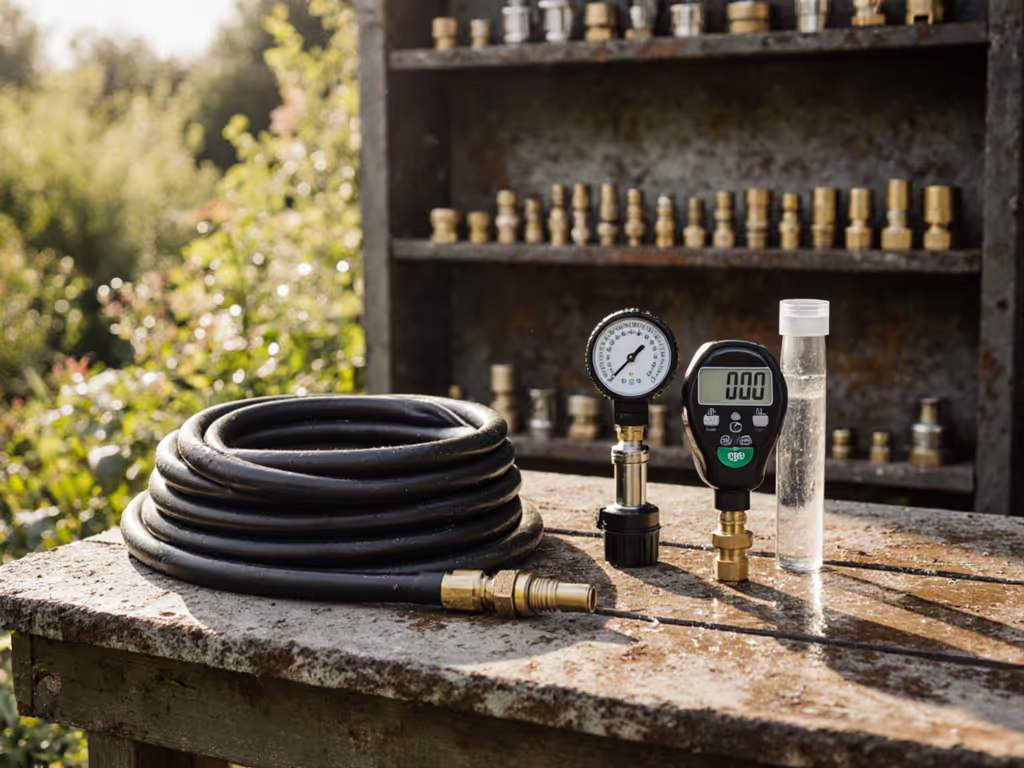
- Attach a pressure gauge to the hose outlet (before any nozzle).
- Open the spigot fully. Read the pressure. Turn on a sprinkler or open nozzle. Record the drop.
- Pass threshold: Steady pressure ≥40 PSI at the nozzle, no leaks at fittings for 5 minutes of continuous flow.
- Fail threshold: Pressure below 35 PSI, leaks, or erratic flow.
Pressure-spike test:
- Close the nozzle suddenly while flow is running. Gauge the spike (water hammer effect). To reduce damaging surges, follow our garden hose water hammer prevention guide.
- Vintage hoses tolerate ~120 PSI spikes; modern ones, ~200+ PSI.
- Fail threshold: Hose bulges visibly or sprays after shut-off.
If a historic hose passes all three, it's suitable for automatic garden watering on a flat, low-pressure zone (soaker circuits, drip lines, or lawn sprinklers at 30-40 PSI). Do not use it for pressure-washing, hot-water tasks, or high-flow demand.
Should You Preserve or Replace?
Here's where skepticism meets pragmatism. A beautifully marked 1940s reel with a vintage hose is a charming garden artifact (if it's primarily decorative and tested safe). If you're using it daily, the pressure budget math doesn't favor it:
Preservation case (museum or heritage property):
- Hose passes all three tests (visual, flow, spike).
- You connect it to a single, low-demand task (hand-watering delicate herbs, no shared demand).
- You inspect it monthly and drain fully before winter.
- You document baseline performance (pressure, GPM) for future reference.
- Cost: Adapter fittings ($5-$15) and time. Benefit: Authenticity and historical continuity.
Replacement case (active home garden):
- You need reliable, consistent flow to multiple zones simultaneously.
- The vintage hose shows even minor cracks or fluctuating pressure.
- You want a 5-10 year service life with zero returns or mid-season failures.
- Cost: $40-$150 for a modern professional-grade hose, reel, and quick-connect kit. Benefit: Predictable performance and peace of mind.
The question isn't "Can I use this old hose?" It's "What does my system need to do, and does this hose reliably deliver within my pressure budget?"
What About Mixing Old and New Components?
This is where compatibility fails most often. A vintage spigot (pre-1960) with straight threads will not seal reliably to a modern snap-on nozzle without an intermediate threaded adapter. A 1970s reel with a 5/8-inch outlet will throttle a modern 3/4-inch hose if connected via a reducer, creating friction loss and starving a far-end sprinkler.
Each mismatched component is a test of patience. You're chasing leaks, pressure drops, or flow stutters. Systems thinkers who hate recurring friction should avoid the temptation to "make it work." A matched heritage garden watering kit (vintage hose, appropriate adapter or coupler, modern low-pressure reel) is coherent. A Frankenstein mix of 80-year-old fittings and last year's nozzle is not.
Where to Find Reliable Data
Historic garden-hose archives are scarce, but museum conservation programs, regional agricultural extension services, and hose manufacturers' spec sheets (when available on microfilm or archives) provide benchmarks. Water-pressure testing labs have published burst-pressure data on salvaged samples. Before committing to a restoration project, contact your local historical society or botanical garden; they may have tested similar equipment and can share thresholds.
For preservation garden irrigation at heritage properties, work with conservators who have done pressure-flow audits. They'll give you a pass/fail call and safe-use guidance tailored to your soil, plants, and climate.
The Bottom Line
Historic garden hoses are engineering artifacts, not interchangeable with modern systems. Compatibility depends on thread standards, material integrity, and pressure tolerance (all measurable, none guaranteed by age or appearance). If you're drawn to vintage hoses for aesthetic or historical reasons, test them rigorously, use them on low-demand tasks, and treat them as supplementary to a modern, matched system. If you're gardening for yield, consistency, and longevity, measure flow at the spigot; design back from the task. For task-specific pressure targets and testing steps, see our gardening water pressure guide. Your pressure budget is limited, and every fitting, hose length, and diameter choice matters.
Related Articles